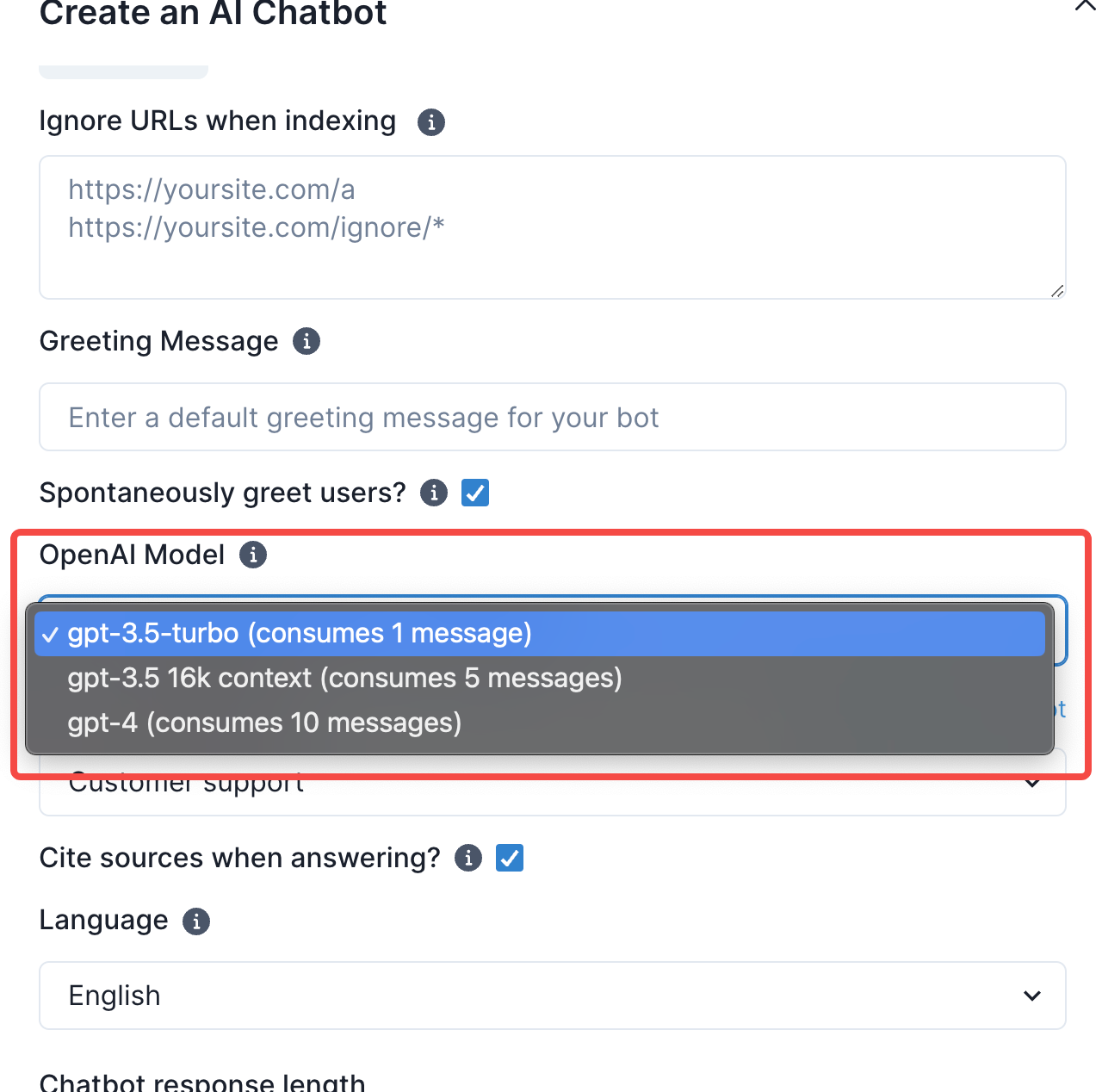
We support a number of different models provided by multiple AI service providers, namely OpenAI, Anthropic, Minstral, Llama, Cohere, Gemini and many more, each with their own series of models. Each model has its own unique specifications and use cases, and in this guide we will explain how to choose the best model for your use case.
Choosing between AI Models
OpenAI Models
1. GPT-4
| Attribute | Details |
|---|
| Description | The original GPT-4 model is a large multimodal model that accepts both text and image inputs, providing advanced reasoning and problem-solving capabilities. |
| Costs | 20 messages per user query and chat response |
| Strengths | Exceptional at complex language tasks, capable of generating coherent and contextually relevant text. It offers high accuracy and is optimized for chat applications. |
| Use Cases | Suitable for applications requiring deep understanding and generation of text, such as customer support, content creation, and educational tools. |
2. GPT-4 Turbo
| Attribute | Details |
|---|
| Description | A variant of GPT-4 that is optimized for speed and efficiency while maintaining high performance. |
| Costs | 10 messages per user query and chat response |
| Image Reading Capabilities | Available |
| Strengths | Faster response times compared to the standard GPT-4, making it ideal for real-time applications. Supports vision capabilities and function calling. |
| Weaknesses | More expensive than the GPT-4o models due to higher intelligence and resources required |
| Use Cases | Best for chatbots and applications needing quick interactions, such as virtual assistants and interactive games. |
3. GPT-4o
| Attribute | Details |
|---|
| Description | The "omni" model that is multimodal, accepting both text and image inputs, designed for a broader range of tasks. |
| Costs | 5 messages per user query and chat response |
| Image Reading Capabilities | Available |
| Strengths | Higher intelligence than previous models, cost-effective, and capable of handling complex tasks efficiently. |
| Weaknesses | Complexity in use, higher risk of toxic output, potential inconsistencies in response quality |
| Use Cases | Ideal for applications that require both text and image processing, such as content creation, data analysis, and customer service. |
4. GPT-4o Mini
| Attribute | Details |
|---|
| Description | A smaller and more affordable version of GPT-4o, optimized for lightweight tasks while still offering advanced capabilities. |
| Costs | 1 messages per user query and chat response |
| Strengths | Cost-effective, fast, and capable of handling various tasks. |
| Weaknesses | Reduced performance on complex tasks, limited functionality compared to larger models, susceptibility to errors |
| Use Cases | Suitable for smaller applications, such as chatbots, virtual assistants, and basic content generation where speed and cost are priorities. |
*GPT-4o mini 60k context is an alternative model to the GPT-4mini model provided that provides for better quality answers due to a larger context window included
In Summary:
In summary, if you are working on a budget or with limited resources, GPT-4mini is a suitable choice
- If your application doesn’t require extensive context memory or complex function calling, GPT-4mini will serve you well
- If you require your AI to have a large context window because you have a long custom instruction for your chatbot, GPT-3.5 Turbo (16k) is a good choice.
- If you need your chatbot to constantly cite accurate links or for your chatbot to do advanced maths or calculation, GPT-4 is the way to go
Selecting Between Claude AI models
Anthropic has released several models of its Large Language Model series, each with its own unique specifications and use cases. In this document, we will discuss the most optimal use cases for these models.
The difference between Anthropic AI models lies in their capabilities and pricing tiers. Anthropic's new family of AI models, Claude 3, consists of three models: Claude 3 Opus, Claude 3 Sonnet, and Claude 3 Haiku
1. Claude Opus
| Attribute | Details |
|---|
| Description | Exceptional performance on highly complex tasks with near-human fluency and understanding |
| Costs | 20 messages per user query and chat response |
| Strengths | Exceptional performance on highly complex tasks with near-human fluency and understanding |
| Weaknesses | Most expensive model in the Claude series |
| Use Cases | Advanced research tool to look at complex research documents. As a critical analysis assistant for a corpus of reports. |
2. Claude Sonnet
| Attribute | Details |
|---|
| Description | Exceptional performance on highly complex tasks with near-human fluency and understanding |
| Costs | 20 messages per user query and chat response |
| Strengths | Exceptional performance on highly complex tasks with near-human fluency and understanding |
| Weaknesses | Most expensive model in the Claude series |
| Use Cases | Advanced research tool to look at complex research documents. As a critical analysis assistant for a corpus of reports. |
3. Claude Haiku
| Attribute | Details |
|---|
| Description | Fastest and cheapest model for near-instant responsiveness. Answers simple queries and requests with unmatched speed. Suitable alternative to the GPT-4mini model. |
| Costs | 1 messages per user query and chat response |
| Strengths | Most cost-effective model in its intelligence category |
| Weaknesses | Limited to simple queries, may not handle complex tasks as well as Sonnet or Opus. May not be as fluent in handling multilingual chats. |
| Use Cases | FAQ bots trained on a simple knowledge base that provide quick answers to common questions without needing in-depth analysis or a nuanced understanding of the user’s query. |
Other AI models: Mistral, Llama, Gemini and Cohere AI models
1. Mistral Small
| Attribute | Details |
|---|
| Description | Fastest and cheapest model for many simple tasks. |
| Costs | 1 messages per user query and chat response |
| Strengths | Fastest and cheapest model for many simple tasks. Suitable alternative to the GPT-4mini and Claude Haiku models. EU based AI model. |
| Weaknesses | Limited to simple queries. May not have the same level of support as the more established models. Performance varies based on task complexity. |
| Use Cases | FAQ bots trained on a simple knowledge base that provide quick answers to common questions without needing in-depth analysis or a nuanced understanding of the user’s query. |
2. Gemini 1.5 Flash
| Attribute | Details |
|---|
| Description | AI model designed by Google with real time information access. |
| Costs | 5 messages per user query and chat response |
| Strengths | Can access up to date information from the web, however may have limited functionality and adherence to base prompts as compared to OpenAI and Claude models |
| Weaknesses | Queries are not within scope. May not have the same level of support as the more established models. Performance varies based on task complexity. |
| Use Cases | For research purposes, where the chatbot does not have to adhere to a corporate brand but is allowed freedom to access the web. |
3. Command R Plus
| Attribute | Details |
|---|
| Description | A model optimized for fast responses, designed for real-time applications. |
| Costs | 5 messages per user query and chat response |
| Strengths | Fast response times suitable for immediate interactions. |
| Weaknesses | May sacrifice depth and detail in responses for speed. |
| Use Cases | Chatbots that require quick, straightforward answers to user inquiries. |
4. Llama 7B
| Attribute | Details |
|---|
| Description | An open-source model that is lightweight and customizable |
| Costs | 1 message per user query and chat response |
| Strengths | A model with a large context window, allowing it to have decent quality responses at a relatively low cost |
| Weaknesses | It may not be able to follow instructions from the base prompt as accurately as Claude and OpenAI models. It may also perform more poorly in multilingual tasks. |
| Use Cases | Chatbots that require quick, straightforward answers to user inquiries. |
5. GPT-Router
| Attribute | Details |
|---|
| Description | The GPT router helps to route your queries to the best OpenAI model available to answer your user query |
| Costs | 5 message per user query and chat response |
| Strengths | The smart router picks the best model available for your user query, allowing you to potentially save on the cost of using a more expensive model. |
| Weaknesses | Chat response quality may be inconsistent, as the router may not always route to the smartest model. |
| Use Cases | Chatbots that do not strictly need to stick to their corporate brand or base prompts, used as a simple virtual assistant such as a chatbot embedded within a. small scale help center. |